Related sites:
Newsletter: Perspectives on Power Platform
Company: Niiranen Advisory Oy

After 18 years of blogging on WordPress directly, the time has come to adjust my setup by separating the content layer and the presentation layer.
I did my very first experiments with blogging on Google’s Blogger. Then I explored whether the all powerful Drupal could work for me (it never did). Once I deployed WordPress in 2008 and started writing this blog as Surviving CRM, I’ve been on that platform ever since.
Now, things are changing a bit. I’m not completely throwing away WP but I am reducing my dependencies on it. The TL;DR is: if you’ve been receiving these blog posts via email from wordpress.com, that’s NOT going to work in the future anymore. Apart from that, RSS feeds and the blog itself are expected to continue existing pretty much as-is.
No, I’m not going to just vibe code the whole thing myself. Reality is always more nuanced than the stories you see on social media about the death of [whatever]. For those who are interested, I’ll share the thinking and experiences behind my years on WordPress and what conclusions I’ve made from them.
My first WP deployment ran on a generic shared web hotel that was dirt cheap. For €20 per year, I wasn’t limited to one web application: I could install loads of fun lil’ PHP apps and MySQL databases. In fact, I still pay for the Suncomet Webhotelli Startti package and it’s still only €24/y. Nothing of practical value runs on it anymore but it has sentimental value to me. Because of all the web experiments it made possible for me when I was a young guy learning to navigate the world of business software.
Recently I turned all the remaining sites on Suncomet into static sites and ensured no unmaintained PHP code was left running there. Codex and Claude Code did all of this for me of course. Looking at the recent PHP2SHell panic, at least I had one less box to worry about now as a result of that clean-up work.
In 2019, when I rebranded from survivingcrm.com to jukkaniiranen.com, I thought it was about time to get a more serious WordPress hosting service. I had heard good things about Shellit and decided to establish my new blog identity there, while moving all the post content along with me, of course. One WP instance plus a .com domain was €75 per year. Quite reasonable for a personal blog.
Seven years later, the same bill is €158. Knowing what’s been happening to hardware costs, it’s not surprising to see hosting services raise their prices. If that service fee gave me peace of mind that my WP site is in good hands, that would be perfectly acceptable. Yet in practice, it has never felt like a premium service that would have significantly differed from my cheapo €20/y generic hosting plan. In recent months, the uptime for Shellit servers has actually been piss poor:
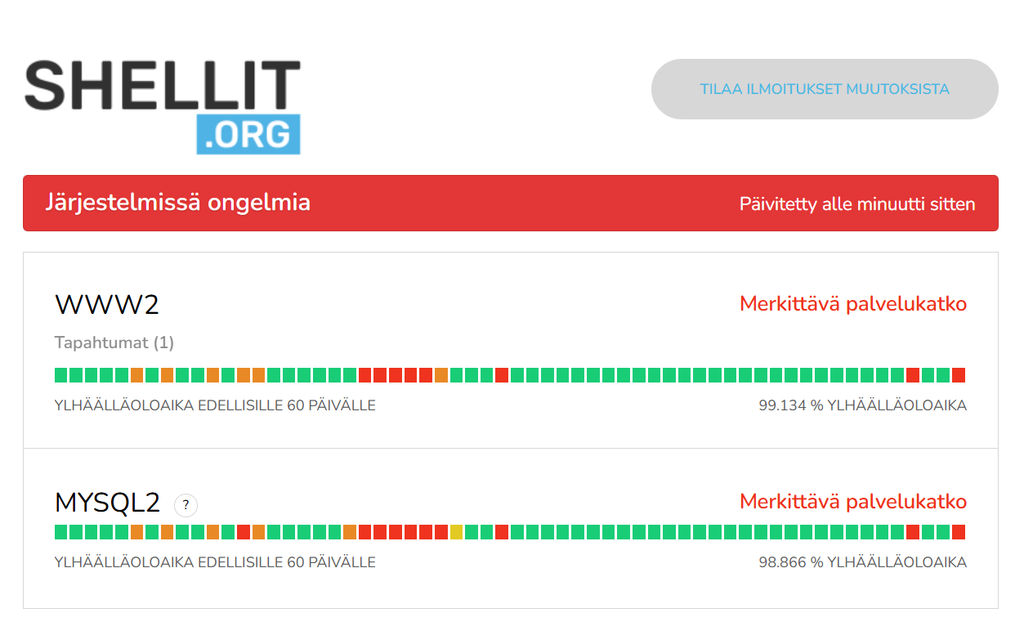
Going below 99% uptime with outages across several different days crossed a threshold. Occasional downtime had occurred throughout the years, yet this year I found myself thinking about the hosting service way too often. The whole reason for paying someone to offer a dedicated WP hosting plan was that I wanted someone else to think about it for me. Now, I just had my web eggs in someone else’s basket and I had to worry about when they were gonna trip over again.
Meanwhile, LLMs arrived and made it possible for even Windows guys like me to configure and operate Linux machines. In Spring 2025 I signed up for my own VPS in Hetzner’s Finnish datacenters. It currently costs me €12 per month and I’m free to do whatever with that server, including running WordPress sites. So I have a few there, such as The Licensing Guide.
How am I doing with my vibe administered server vs. professional WP hosting? Based on UptimeRobot stats from the past half a year, I’ve had a single self-inflicted downtime incident on Hetzner and the site was down for 38 minutes. Meanwhile, my Shellit hosted site was down for 18 hours across 64 incidents. That’s almost 30x downtime for something I pay others to manage.
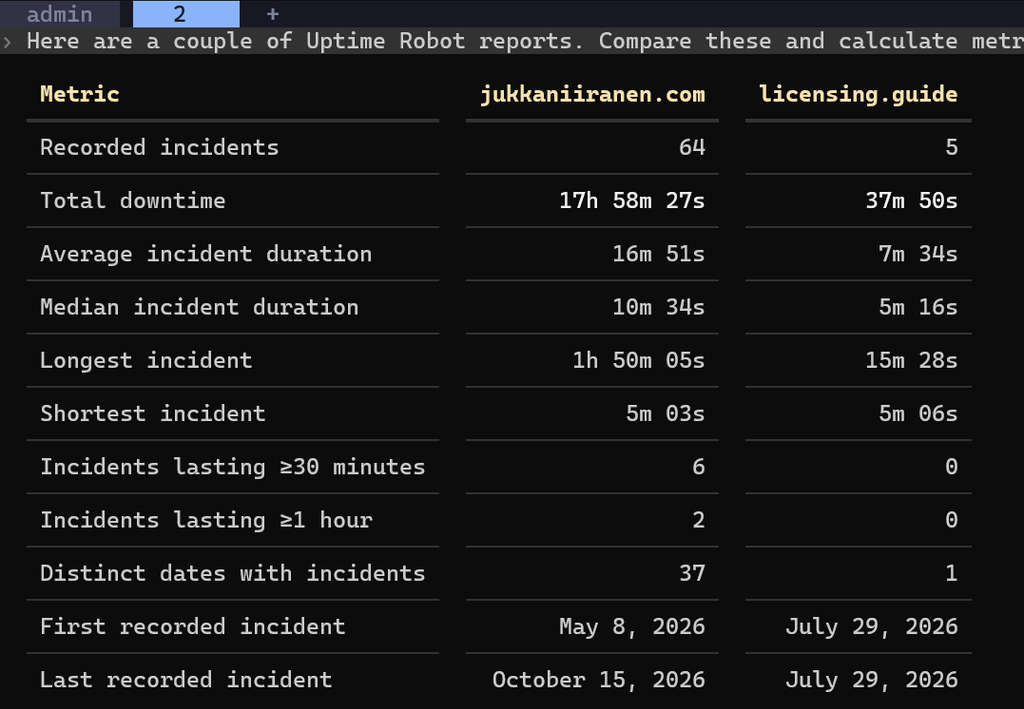
The self-inflicted downtime was about adjusting the fail2ban plugin settings in response to a rise in abusive WP login traffic, and letting my agents do things that weren’t properly tested (because who needs test environments?). Given how a while earlier this one security architect had started publicly threatening me on LinkedIn about attacking my websites after I had refused to believe his unverified claims about WireGuard security gaps, I was somewhat cautious about anomalies. Better safe than sorry, and in this case it was totally expected that security hardening tasks might eventually cause some operational problems for my VPS. Such is IT life.
Meanwhile, the issues that were affecting the professional WP hosting provider ranged from DDOS attacks to broken fiber cables in the datacenter. For the most part, though, there was never any proper explanation. It seems like the company (Multim Oy) doesn’t really exist online or on the socials, so the entire customer relationship consisted of A) their control panel, B) the service status page, and C) the annual bill. It’s not exactly an optimal way to build empathy towards the service provider. I don’t expect others to be terminally online like me or ultra-transparent on what they’re working on, but the end result is a lack of trust and goodwill for when things go wrong. And they always do, at some point of any longer term customer relationship. Such is CRM life.
I’ve done my fair share of business experiments with WordPress in the past 18 years. It would be easier to count the things I’ve done related to web content/apps that would not have been WP based. The logical outcome from this is a love/hate relationship with the tools.
The actual writing work done via the WP admin UI has always felt natural and practical. When considering the number of blog posts I’ve written over the years on various WP sites, I must have spent more time inside wp-admin than probably any other non-Microsoft piece of software. It’s where so much of my thinking has taken place that the tool has certainly shaped it in some ways.
Everything else about WP sites has been something I’ve more or less had to tolerate. The vast plugin ecosystem meant there’s always been seemingly easy ways to extend and modify what the sites do. Yet without a central authority curating which tool to use for what, let alone how the tools themselves are designed, you always end up with an ever-growing pile of custom code running inside your WP. Every passing month you’re less sure about what you’ve got there and eventually you’d just want to start from a clean slate – only to end up in the same situation later. And that’s before we even get to tweaking the themes…
Last year, when working with a business partner to launch FinModeler (which I’ve since left), the WordPress curse became all too clear for me. When still envisioning what our offering or brand was going to be, I made a one-shot mockup with Lovable to demonstrate “hey, this is what our site could look like”. It was amazing ROI for only a few prompts. At least compared to the two rounds of WP site design that we ended up doing in the first couple of months. It all felt like way too much work just to get to a state where we had Yet Another SaaS Site with the core functionality to support customer onboarding.
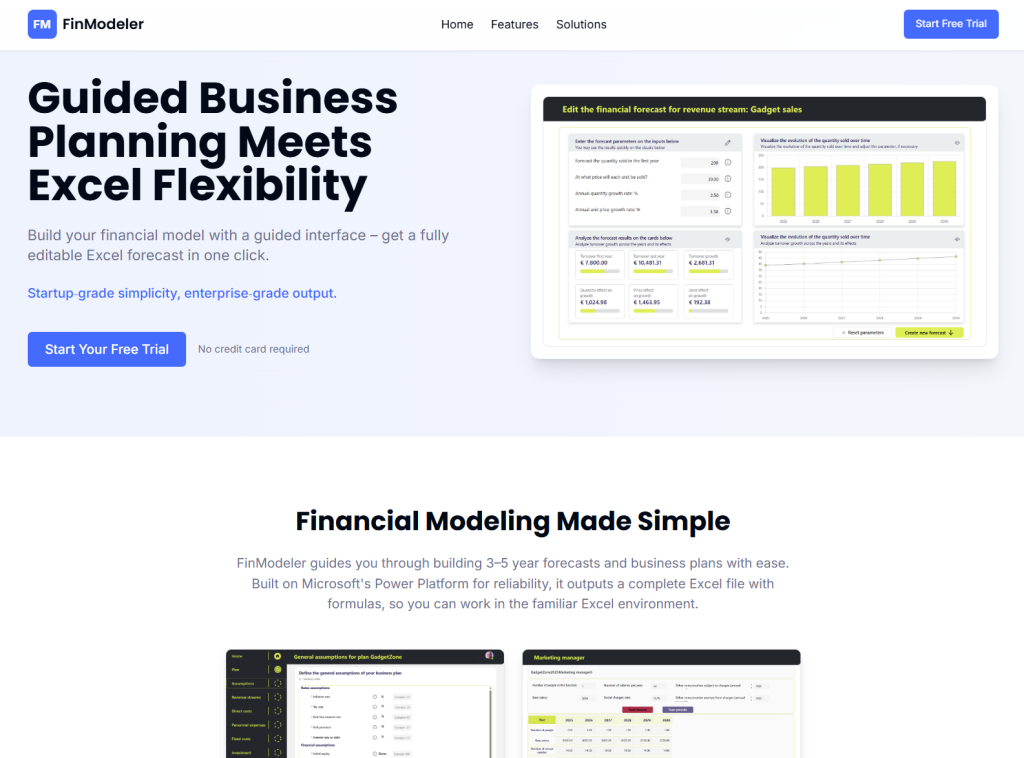
Fast forward to 2026 and it’s now clear to me the entire product should have been built on Lovable. Because the other part that was draining my energy was trying to twist Power Platform into delivering both the front-end and the back-end of what a SaaS product needed for managing trials, identities, messages, the whole shebang. It’s of course not Microsoft’s intended target audience at all and I fully knew that. I also knew technically how it could have been done. Yet having to fight the system and build things from the ground up ended up being another battle draining too much energy, while not leaving enough of it for the business side of the product.
The arrival of AI coding agents that can deliver useful outputs for even code-illiterate people like me has challenged my assumptions of what it means to create solutions from software. Things will never quite be the same, no matter what happens with the financial market bubble. Comparing the posts I’ve written about democratizing code, first in 2021 on this blog and then in 2026 on my newsletter, the things you can do without writing code have expanded dramatically. APIs and CLIs are now the preferred tool over GUIs when I want to get things done. Any tool that doesn’t easily let coding agents interact with it gets replaced by a tool that is better aligned with this new reality.
That finally gets us to the question I’ve been asking myself and the reason this blog post is getting written. Is WordPress something that helps me get things done or is it an obstacle that’s slowing me down?
WordPress remains a perfectly fine CMS for the small-scale content management needs I have. When used as a tool for designing how that content is presented on the web, I hate working with it. There’s an endless number of themes available, with a wealth of options to configure, and blocks that allow you to do all sorts of fancy things. That is, if you want to learn all the different tools from various builders and how they behave. I’d rather not touch any of it.
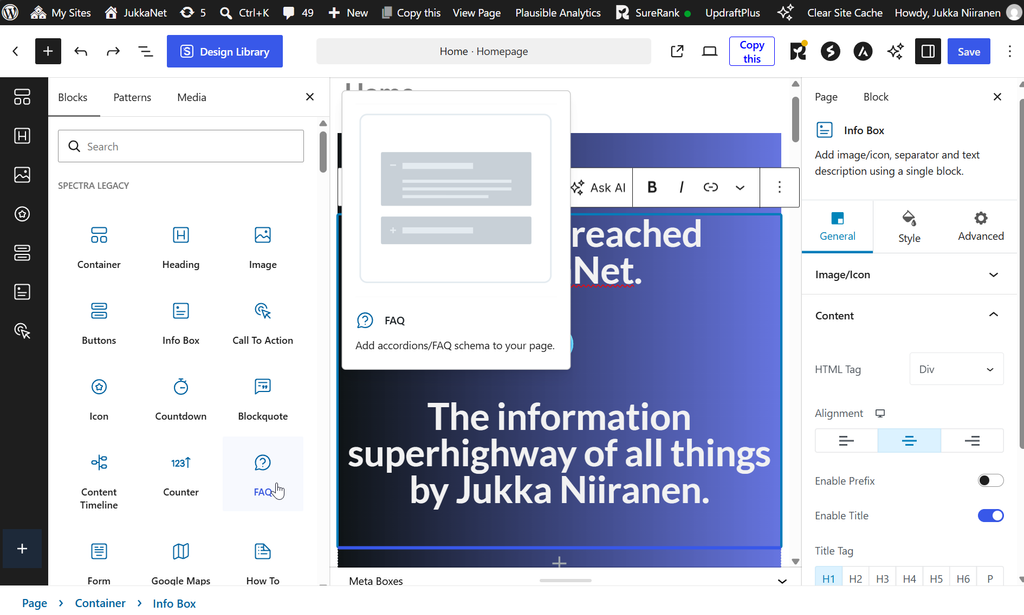
I didn’t write the code for my earlier WordPress sites (obviously, given my no-code background). I took themes and plugins from others and then tweaked a few settings. I had very little idea of what I was doing. Now, I could of course just ask Claude to tweak a WP theme for me and it might be able to deliver something decent. Yet I’d be stuck with trying to get AI to use the middle layer, losing the little understanding I had of how to adjust the same things manually. Why not just skip the layer altogether?
Whether it’s business apps or websites, LLMs have demonstrated that the front-end code is as simple and quick for them to process as human language is. This in itself doesn’t mean that human professionals wouldn’t possess abilities beyond what AI agents can do. In writing, it still feels offensive when someone responds like a non-human. The many sloppy websites and GitHub repos that coding agents are creating have a similar problem of making me zone out when there’s no sign of human thought or touch.
Yet sometimes it’s not a problem. When you use AI to get to the result, in collaboration with the agents, and you assume the ownership of what the end result is — go for it. If it’s good enough to put your name on it and stand behind it, then it’s just normal technology. Tools that help you get things done in a way that you couldn’t have achieved without such tools.
Soon after posting this one last native WordPress issue, I will migrate the blog to the new architecture. WP back end will run on my VPS with core CMS functionality. The front end website will be served by Lovable Cloud. Content will remain available via the same URLs. A reader (human or bot) will see the same blog posts on the web and the RSS feed should keep serving the data.
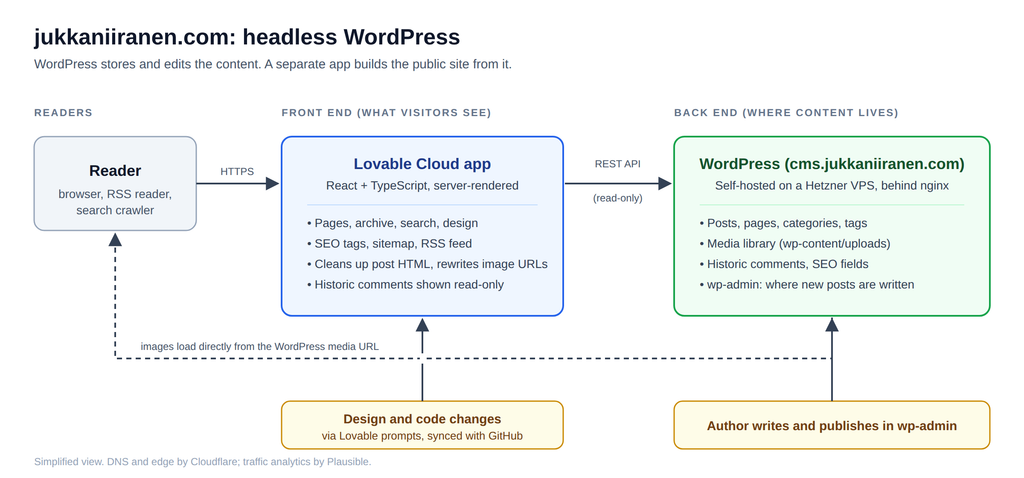
Comment authoring will be unavailable and the old ones persisted as static copies. Given how little activity there is on this blog anymore compared to the times before my newsletter, I don’t feel like setting up an alternative system for it. The amount of spam comments that still get through despite all the filters isn’t likely to go down as LLMs get better, unfortunately.
The email subscription service delivering updates about new posts has relied on Jetpack from Automattic. I do not want to install it on the destination WP site because of the loss in trust incurred by the actions of Automattic’s CEO, already mentioned in my post from 2 years ago. Since I already write a weekly email newsletter on Perspectives.plus, implementing a second subscriber list here would feel redundant.
That does not mean I wouldn’t care about the readers. The community is what has kept me writing this blog for 18 years. If it wasn’t for the people out there who have supported me and encouraged me to write more, I would have given up a long time ago. These days, I write far more actively than ever before, but it just happens on a different site. I want to invite you all there.
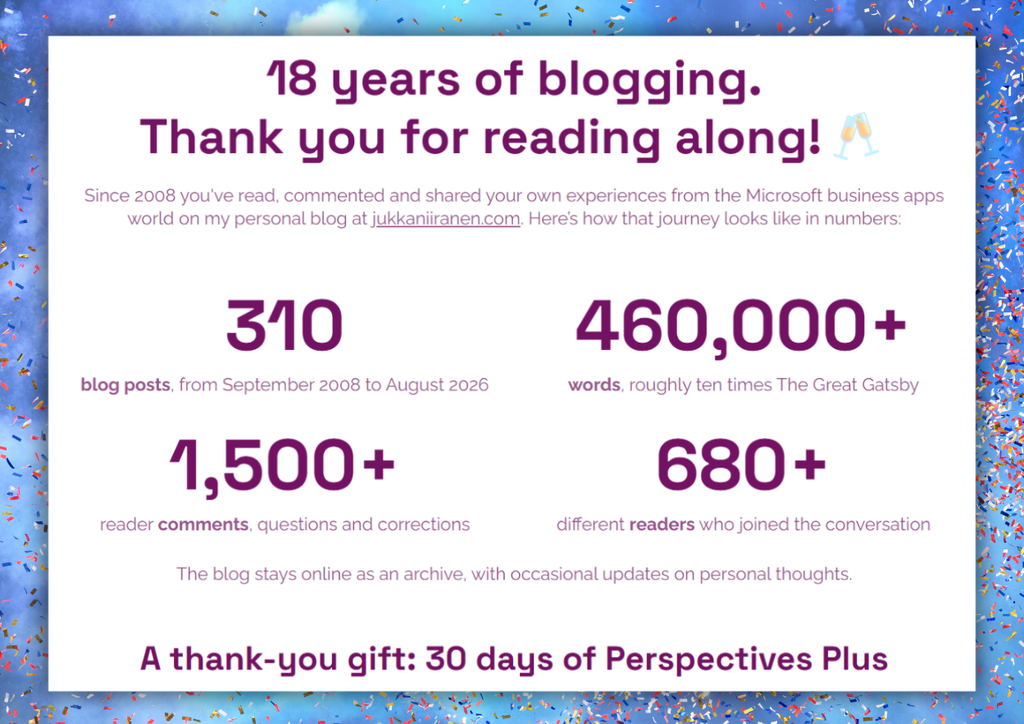
Click this link to get 30-day free access to all of the content I’ve published on Perspectives on Power Platform. Over 125 issues with around 300k words already, even though it’s been operating for only two and half years. There’s a new issue every week for Plus subscribers.
The Plus trial does not require a credit card and nothing will be charged, unless you decide to activate the paid premium subscription after the trial. There is plenty of content for free subscribers, too. I don’t make my living from writing, but I’ve also noticed I wouldn’t want to live without writing.
Cover photo by Shaofong Huang on Unsplash